I consider Lilly Ghahremani of Full Circle Literary (there is a link to her website on this blog) a mentor. Even though this lovely lady is half my age, she and some of the other agent/faculty at this year's Pikes Peak Writers Conference, taught me more about pitching and marketing than I ever thought I'd know. I even had the opportunity to pitch Lilly in person. In fact, she is the agent I mention in one of the early posts in this blog.
Well, although she didn't find my book one she thought she could pitch to editors, I did give my wife, Rebecca Bibbs, her name and now she has sent a query to Lilly. Rebecca is a far better writer than I am and I am sure Lilly will want to learn more about her novel, The Nubian Codex.
Lilly did like my blog. Here is what she said about it:
You did a great job with this blog! I think it will get you great media attention especially if you pitch it to media in the few months leading up to the anniversary. You even linked to Jonestown info and sources-- nice work and... Good luck Jeff!
Lilly
Every now and then, an agent will provide you with a rosebud among the thorns. Perhaps someday, I'll get the whole bouquet.
Rebecca's blog is at http://rosielarue.blogspot.com Check it out.
Monday, May 7, 2007
Saturday, May 5, 2007
Kinder and Gentler Rejections
The other day I received the nicest rejection ever. It almost made me feel as though I had accomplished something. It read:
Thanks for your interest in our agency. As you may know, I run a very small business and unfortunately there are periods when the time that I have to consider new material is very limited. Unfortunately you've caught me during one of those periods. Since I can not offer to consider your work in a timely manner I must pass with the hope that you will find an agent who can offer the attention that this deserves.
Sincerely,
Then there is this short reply from the owner of an agency that gives the author a slim hope for acceptance. I'll get back with you on how this one goes:
I'm passing your query on to Xxx Xxxxxxx, another editor in my company.
Sincerely,
Thanks for your interest in our agency. As you may know, I run a very small business and unfortunately there are periods when the time that I have to consider new material is very limited. Unfortunately you've caught me during one of those periods. Since I can not offer to consider your work in a timely manner I must pass with the hope that you will find an agent who can offer the attention that this deserves.
Sincerely,
Then there is this short reply from the owner of an agency that gives the author a slim hope for acceptance. I'll get back with you on how this one goes:
I'm passing your query on to Xxx Xxxxxxx, another editor in my company.
Sincerely,
Friday, May 4, 2007
The Anniversary Syndrome
(I wrote this essay for the Jonestown Institute's annual newsletter a couple of years ago.)
There was a time when I did not believe in Post Traumatic Stress Disorder (PTSD). Part of the reason for my skepticism may be that I was a professional soldier, and psychological disorders, particularly this one, were often considered career-enders.
I served two tours in Vietnam as a medic with the 85th Evacuation Hospital. I worked a minimum of 12 hours a day, seven days a week on the Recovery Room/Intensive Care Unit. It was not pleasant duty. Day after interminable day, we treated American soldiers, airmen and marines with horrendous wounds of war, civilian women and children who had grotesque burns or missing limbs and enemy prisoners-of-war with wounds so severe, we often were barely able to put them back together again.
Every day represented a new and different assault on the psyche of medics serving on the line or in hospitals. I'd like to believe it was the innate compassion most medical personnel possess that allowed me to perform agonizing duties with professional acumen and the psychological detachment necessary to remain reasonably sane.
Despite these experiences, I did not exhibit any symptoms of PTSD when I returned to the U.S. after my tours in Vietnam. In fact, when I would hear or read about fellow soldiers or vets who acted out in an inappropriate manner, ostensibly because of the trauma they experienced during the war, I considered them frauds or weaklings who were probably psychologically flawed before entering the military. It wasn't until many years later that I recognized exactly how complicated and fragile the mind is.
In 1978, I was confronted by an event so disturbing and so massive in scope that it caused me psychological distress that continues to have an effect on my life to this day. I spent nine days in November of that year as senior medic of the Joint Humanitarian Task Force sent to Guyana to recover the remains of the victims of the Jonestown Massacre.
I was part of a team of about three dozen men and women who were deployed to Guyana on November 20, two days after the deaths. The event that had occurred there happened in an extremely hot tropical climate that caused all sorts of complications for body retrieval, identification, and removal. We also worked under incredible time constraints, since the conditions that hastened body decomposition served to create a very real physical health hazard for our team. Beyond that, the mental strain was almost overwhelming.
To this day, 25 years later, after being afflicted with Parkinson's Disease, after going in and out of states of homelessness for the past five years, after two divorces, and after fighting a powerful gambling addiction, I still consider the nine days spent in Guyana as the worst period of my life.
Yet, immediately after it was over and I returned to my duty station in the Panama Canal, my life seemed to return to normal. For a year, I rarely talked about or even thought about the Jonestown Massacre and my connection to it.
However, as ordinary as my life was during the weeks and months subsequent to this unprecedented military mission, there was a tiny seed of trouble hidden deep within my psyche waiting to emerge and disturb my conscious life. It happened very suddenly and dramatically.
That bad seed began to sprout almost exactly a year of my journey to and from the hell that was Jonestown. It was a Sunday in November 1979. I was walking past the bakery in Balboa, Panama on a peaceful pleasant morning. Delectable aromas were wafting from the open door of the shop, enticing customers to come in and buy the sweet breads and pastries it was famous for. But my olfactory nerves interpreted the odor as being the sickeningly sweet smell created by 914 bodies rotting in the tropical heat. I immediately vomited on the sidewalk.
Embarrassed by this reaction I had no control over, I dashed to my car and quickly returned home. Although not consciously aware of any changes to my normal behavior, I am told that for the next two weeks I was uncharacteristically moody and depressed. I cried for no apparent reason, argued with my spouse over petty and inconsequential grievances and treated my children with impatience and indifference.
My nights were marked by difficulty in falling to sleep and then abruptly waking up in a cold sweat after experiencing very realistic nightmares that resembled scenes from the classic horror film, Night of the Living Dead. It was as if the former residents of Jonestown were literally visiting me. Sleep was not a pleasant restful pastime during the next two weeks.
Just as suddenly as my bizarre behavior manifested itself, it disappeared. My wife and children who had spent a fortnight being cautious and tentative in dealing with me, slowly realized I was my old self again. Life was back to normal again until the following November when the symptoms returned for two weeks.
My family put up with these annual changes for five more Novembers until I finally achieved an epiphany provided by a very unlikely person at a very unusual location. My bowling team at Fort Sill, Oklahoma was participating in our weekly Tuesday night league game. It was my turn to bowl and I picked my ball up from the rack, approached the lane, released the ball and delivered a rare, for me, strike.
Rather than reacting joyously to this happy feat by shouting and issuing traditional high-fives to my teammates, I simply went back to my seat and sat down.
"Brailey, you don't bowl enough strikes that you should be that nonchalant," asked a member of my team who happened to be a psychologist. "What's the matter with you?"
"Nothing," I replied flatly.
Later, over pie and coffee with our spouses, the psychologist looked at me and said, "Do you feel all right? You look pretty depressed."
"I'm fine," I responded, not really realizing nothing could be further from the truth.
"No, he's not," said my Vietnamese wife. "He gets like this around Thanksgiving since he came back from Jonestown."
I am sure a 1000-watt halogen light bulb literally appeared over my head as I heard my wife's pronouncement and consciously recognized that I was indeed weird every November. My psychologist teammate told me to stop by his office the next morning.
He and I spent several hours that week discussing my behavior, its causes and means to control it. I came to learn I had a form of PTSD called "Anniversary Syndrome." It seems people affected by severe emotionally traumatic events are capable of suppressing them for most of the year, but when the date of the event looms annually, it triggers something within the brain that causes one to relive the terrible time.
After a relatively short period of informal therapy sessions, I succeeded in overcoming the bizarre behavior that plagued me for six Novembers. I was actually able to file my Jonestown experiences deep within the recesses of my brain and keep them from surfacing for the next 14 years.
I was a newlywed in February 1998. My second wife and I married on Valentine's Day. A couple of weeks later, we were sitting on our patio drinking coffee on a sunny Saturday morning. The portable phone rang and I answered with a cheery "Hello."
"Hello. My name is Jim Hougan. I am producing a documentary about Jonestown, and I'm looking for Jeff Brailey," a voice on the other end of the line said.
The hair on the nape of my neck stood up as I heard the word "Jonestown" for the first time in about a dozen years. "How did you find me?" I asked cautiously.
"Your name is on the list of soldiers who were on the Joint Humanitarian Task Force and I did an Internet search on your name and found your website. Are you the same Jeff Brailey?" Hougan asked.
I admitted it, and we spent the next 20 minutes chatting about my experiences in Guyana. I agreed to appear in the documentary, and Hougan said he'd come to San Antonio or send me an airline ticket to a city where he would tape the interview.
As I hung up the phone, my bride who had listened to my side of the conversation with wide-eyed curiosity, asked what I was talking about. I told her, "Jonestown."
"You were there?" she asked.
"Yes." I replied.
"IN THE CULT!?!?" she shouted.
"No, part of the cleanup," I said.
We spent the next few hours discussing the massacre and then went on to enjoy the remainder of our Saturday. That night, my wife shook me awake from a restless sleep. I asked why she had woken me up. "Because you were screaming in your sleep," she replied with a look of fear on her face.
"Uh oh, they're back," I said resignedly.
"Who's back," she asked.
"The ghosts," said I.
I went on to explain the Anniversary Syndrome that had bothered me years before. But this was February, not November, and I was a little rattled by it.
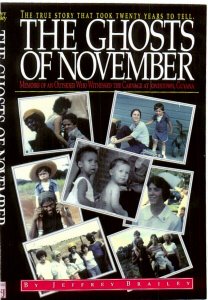
It was that very night The Ghosts of November: Memoirs of an Outsider Who Witnessed the Carnage at Jonestown, Guyana was conceived. It was my wife's idea that if I wrote about it, the ghosts would go away. I wrote the book in four months. It was published and released by J&J Publishers on October 31, 1998.
Writing the account of my nine days in Guyana, appearing on radio talk and television news shows, speaking at book signings and to civic groups, all were cathartic experiences that seem to have exorcised my ghosts for the time being.
Anniversary Syndrome is not the only ill-effect that Jonestown had on my life. Although I was brought up in the church and attended a Christian college, my spiritual life has never been the same. I still consider myself a Christian, but I am a very cynical nontrusting one.
While I still have a belief in God, my faith has been shattered. I will not trust His self-appointed representatives. It was not long after Jonestown that Jim and Tammy Bakker's sins against their flock were exposed, that Jimmy Swaggart tearfully confessed his infidelities, that Oral Roberts conned thousands of his followers into sending him millions of dollars so God would not "take him home," and that Robert Tilton was caught bilking gullible elderly Christians living on fixed incomes out of their money.
I began equating the antics of God's conmen with the evil deeds of Jim Jones that culminated in the taking of 914 lives in Jonestown. In my mind, most television evangelists are no better than he was, and the only thing that separates them from him is the fact that they have not become homicidal maniacs – yet.
Jonestown represents the impetus of my self-exile from organized religion, and phony television evangelists continue to provide me with plenty of reasons to continue to eschew the church.
Benny Hinn gives me the creeps, especially since I know he is a charlatan and fraud, yet the faithful continue to flock to and contribute to his dog-and-pony healing shows. Trinity Broadcasting and its boss, holy roller Paul Crouch, remind me of the power and charisma which Jim Jones used to control people. There are many more greedy and corrupt ministers using the media to make themselves rich.
Jonestown has alienated me from God. I suppose you could say this is evidence that far from being the God he claimed to be, Jones was actually Satan's servant.
At one time I believed that no matter how bad something turned out, there was always something to learn from every human experience, that some good would come from it, no matter how seemingly devastating the immediate outcome of it was. When I look back at the nine days I spent in Jonestown and the monumentally evil deeds that caused me to go there, I can honestly say I find no redeeming value in that experience.
There was a time when I did not believe in Post Traumatic Stress Disorder (PTSD). Part of the reason for my skepticism may be that I was a professional soldier, and psychological disorders, particularly this one, were often considered career-enders.
I served two tours in Vietnam as a medic with the 85th Evacuation Hospital. I worked a minimum of 12 hours a day, seven days a week on the Recovery Room/Intensive Care Unit. It was not pleasant duty. Day after interminable day, we treated American soldiers, airmen and marines with horrendous wounds of war, civilian women and children who had grotesque burns or missing limbs and enemy prisoners-of-war with wounds so severe, we often were barely able to put them back together again.
Every day represented a new and different assault on the psyche of medics serving on the line or in hospitals. I'd like to believe it was the innate compassion most medical personnel possess that allowed me to perform agonizing duties with professional acumen and the psychological detachment necessary to remain reasonably sane.
Despite these experiences, I did not exhibit any symptoms of PTSD when I returned to the U.S. after my tours in Vietnam. In fact, when I would hear or read about fellow soldiers or vets who acted out in an inappropriate manner, ostensibly because of the trauma they experienced during the war, I considered them frauds or weaklings who were probably psychologically flawed before entering the military. It wasn't until many years later that I recognized exactly how complicated and fragile the mind is.
In 1978, I was confronted by an event so disturbing and so massive in scope that it caused me psychological distress that continues to have an effect on my life to this day. I spent nine days in November of that year as senior medic of the Joint Humanitarian Task Force sent to Guyana to recover the remains of the victims of the Jonestown Massacre.
I was part of a team of about three dozen men and women who were deployed to Guyana on November 20, two days after the deaths. The event that had occurred there happened in an extremely hot tropical climate that caused all sorts of complications for body retrieval, identification, and removal. We also worked under incredible time constraints, since the conditions that hastened body decomposition served to create a very real physical health hazard for our team. Beyond that, the mental strain was almost overwhelming.
To this day, 25 years later, after being afflicted with Parkinson's Disease, after going in and out of states of homelessness for the past five years, after two divorces, and after fighting a powerful gambling addiction, I still consider the nine days spent in Guyana as the worst period of my life.
Yet, immediately after it was over and I returned to my duty station in the Panama Canal, my life seemed to return to normal. For a year, I rarely talked about or even thought about the Jonestown Massacre and my connection to it.
However, as ordinary as my life was during the weeks and months subsequent to this unprecedented military mission, there was a tiny seed of trouble hidden deep within my psyche waiting to emerge and disturb my conscious life. It happened very suddenly and dramatically.
That bad seed began to sprout almost exactly a year of my journey to and from the hell that was Jonestown. It was a Sunday in November 1979. I was walking past the bakery in Balboa, Panama on a peaceful pleasant morning. Delectable aromas were wafting from the open door of the shop, enticing customers to come in and buy the sweet breads and pastries it was famous for. But my olfactory nerves interpreted the odor as being the sickeningly sweet smell created by 914 bodies rotting in the tropical heat. I immediately vomited on the sidewalk.
Embarrassed by this reaction I had no control over, I dashed to my car and quickly returned home. Although not consciously aware of any changes to my normal behavior, I am told that for the next two weeks I was uncharacteristically moody and depressed. I cried for no apparent reason, argued with my spouse over petty and inconsequential grievances and treated my children with impatience and indifference.
My nights were marked by difficulty in falling to sleep and then abruptly waking up in a cold sweat after experiencing very realistic nightmares that resembled scenes from the classic horror film, Night of the Living Dead. It was as if the former residents of Jonestown were literally visiting me. Sleep was not a pleasant restful pastime during the next two weeks.
Just as suddenly as my bizarre behavior manifested itself, it disappeared. My wife and children who had spent a fortnight being cautious and tentative in dealing with me, slowly realized I was my old self again. Life was back to normal again until the following November when the symptoms returned for two weeks.
My family put up with these annual changes for five more Novembers until I finally achieved an epiphany provided by a very unlikely person at a very unusual location. My bowling team at Fort Sill, Oklahoma was participating in our weekly Tuesday night league game. It was my turn to bowl and I picked my ball up from the rack, approached the lane, released the ball and delivered a rare, for me, strike.
Rather than reacting joyously to this happy feat by shouting and issuing traditional high-fives to my teammates, I simply went back to my seat and sat down.
"Brailey, you don't bowl enough strikes that you should be that nonchalant," asked a member of my team who happened to be a psychologist. "What's the matter with you?"
"Nothing," I replied flatly.
Later, over pie and coffee with our spouses, the psychologist looked at me and said, "Do you feel all right? You look pretty depressed."
"I'm fine," I responded, not really realizing nothing could be further from the truth.
"No, he's not," said my Vietnamese wife. "He gets like this around Thanksgiving since he came back from Jonestown."
I am sure a 1000-watt halogen light bulb literally appeared over my head as I heard my wife's pronouncement and consciously recognized that I was indeed weird every November. My psychologist teammate told me to stop by his office the next morning.
He and I spent several hours that week discussing my behavior, its causes and means to control it. I came to learn I had a form of PTSD called "Anniversary Syndrome." It seems people affected by severe emotionally traumatic events are capable of suppressing them for most of the year, but when the date of the event looms annually, it triggers something within the brain that causes one to relive the terrible time.
After a relatively short period of informal therapy sessions, I succeeded in overcoming the bizarre behavior that plagued me for six Novembers. I was actually able to file my Jonestown experiences deep within the recesses of my brain and keep them from surfacing for the next 14 years.
I was a newlywed in February 1998. My second wife and I married on Valentine's Day. A couple of weeks later, we were sitting on our patio drinking coffee on a sunny Saturday morning. The portable phone rang and I answered with a cheery "Hello."
"Hello. My name is Jim Hougan. I am producing a documentary about Jonestown, and I'm looking for Jeff Brailey," a voice on the other end of the line said.
The hair on the nape of my neck stood up as I heard the word "Jonestown" for the first time in about a dozen years. "How did you find me?" I asked cautiously.
"Your name is on the list of soldiers who were on the Joint Humanitarian Task Force and I did an Internet search on your name and found your website. Are you the same Jeff Brailey?" Hougan asked.
I admitted it, and we spent the next 20 minutes chatting about my experiences in Guyana. I agreed to appear in the documentary, and Hougan said he'd come to San Antonio or send me an airline ticket to a city where he would tape the interview.
As I hung up the phone, my bride who had listened to my side of the conversation with wide-eyed curiosity, asked what I was talking about. I told her, "Jonestown."
"You were there?" she asked.
"Yes." I replied.
"IN THE CULT!?!?" she shouted.
"No, part of the cleanup," I said.
We spent the next few hours discussing the massacre and then went on to enjoy the remainder of our Saturday. That night, my wife shook me awake from a restless sleep. I asked why she had woken me up. "Because you were screaming in your sleep," she replied with a look of fear on her face.
"Uh oh, they're back," I said resignedly.
"Who's back," she asked.
"The ghosts," said I.
I went on to explain the Anniversary Syndrome that had bothered me years before. But this was February, not November, and I was a little rattled by it.
It was that very night The Ghosts of November: Memoirs of an Outsider Who Witnessed the Carnage at Jonestown, Guyana was conceived. It was my wife's idea that if I wrote about it, the ghosts would go away. I wrote the book in four months. It was published and released by J&J Publishers on October 31, 1998.
Writing the account of my nine days in Guyana, appearing on radio talk and television news shows, speaking at book signings and to civic groups, all were cathartic experiences that seem to have exorcised my ghosts for the time being.
Anniversary Syndrome is not the only ill-effect that Jonestown had on my life. Although I was brought up in the church and attended a Christian college, my spiritual life has never been the same. I still consider myself a Christian, but I am a very cynical nontrusting one.
While I still have a belief in God, my faith has been shattered. I will not trust His self-appointed representatives. It was not long after Jonestown that Jim and Tammy Bakker's sins against their flock were exposed, that Jimmy Swaggart tearfully confessed his infidelities, that Oral Roberts conned thousands of his followers into sending him millions of dollars so God would not "take him home," and that Robert Tilton was caught bilking gullible elderly Christians living on fixed incomes out of their money.
I began equating the antics of God's conmen with the evil deeds of Jim Jones that culminated in the taking of 914 lives in Jonestown. In my mind, most television evangelists are no better than he was, and the only thing that separates them from him is the fact that they have not become homicidal maniacs – yet.
Jonestown represents the impetus of my self-exile from organized religion, and phony television evangelists continue to provide me with plenty of reasons to continue to eschew the church.
Benny Hinn gives me the creeps, especially since I know he is a charlatan and fraud, yet the faithful continue to flock to and contribute to his dog-and-pony healing shows. Trinity Broadcasting and its boss, holy roller Paul Crouch, remind me of the power and charisma which Jim Jones used to control people. There are many more greedy and corrupt ministers using the media to make themselves rich.
Jonestown has alienated me from God. I suppose you could say this is evidence that far from being the God he claimed to be, Jones was actually Satan's servant.
At one time I believed that no matter how bad something turned out, there was always something to learn from every human experience, that some good would come from it, no matter how seemingly devastating the immediate outcome of it was. When I look back at the nine days I spent in Jonestown and the monumentally evil deeds that caused me to go there, I can honestly say I find no redeeming value in that experience.
Thursday, May 3, 2007
Getting Published
Paul Simon sang about 50 ways to leave your lover. If instead of a song, Simon's work was a book manuscript, how many people do you think would have a chance to read it? One of the most difficult tasks for any unpublished writer is getting his work published. While there are more ways than ever before to get your writing read, it seems there are more roadblocks to accomplishing that goal.
The traditional route to publication means finding a literary agent to represent you to the publishing companies. It's more difficult to sign a contract with an agent than it is to contract herpes from a virgin. Evidence of this is the collection of rejection emails I have begun to amass since I have been actively marketing The Ghosts of November. Originally self-published nine years ago, I wanted to go down the traditional trail this time around. Self-publishing, while expedient, is not very satisfying. I think it will be much more fulfilling to actually sell the book to a publishing house. Then all you have to do is edit and review and approve and then wait for the baby to be born. That's when the real work starts though, marketing.
If the quest to obtain a literary agent fails, the motivated writer can always pitch his work to small presses. That takes some effort and no small amount of postage (most small presses do not take electronic submissions), not to mention the trees that dedicate their lives to turning your work into hard copies. But there are a multitude of small presses around and that will be my next strategy should I be unable to convince an agent to represent me.
My wife, Rebecca Bibbs, is toying with the idea of self-publishing her novel, The Nubian Codex. Since she had two editors who wanted to see her work when she attended the 2007 Algonkian Pitch Session, I discouraged that method of publishing. For me its a matter of "Been there, done that," for her its a matter of getting the best bang for the bucks and I have got to believe just being chosen by two editors at Algonkian is a sign from the heavens that she is destined to find a publisher.
Of course there is always the e-book route. That's really a last resort in my estimation. Unless your name is Stephen King, obscurity is bound to become your friend if you choose this method of getting published.
So I am giving it until the end of the month for an incredibly discerning literary agent to realize the uniqueness and marketability of my work and send me a contract. Then small presses, expect some packages from Indianapolis to be arriving in your mail.
The traditional route to publication means finding a literary agent to represent you to the publishing companies. It's more difficult to sign a contract with an agent than it is to contract herpes from a virgin. Evidence of this is the collection of rejection emails I have begun to amass since I have been actively marketing The Ghosts of November. Originally self-published nine years ago, I wanted to go down the traditional trail this time around. Self-publishing, while expedient, is not very satisfying. I think it will be much more fulfilling to actually sell the book to a publishing house. Then all you have to do is edit and review and approve and then wait for the baby to be born. That's when the real work starts though, marketing.
If the quest to obtain a literary agent fails, the motivated writer can always pitch his work to small presses. That takes some effort and no small amount of postage (most small presses do not take electronic submissions), not to mention the trees that dedicate their lives to turning your work into hard copies. But there are a multitude of small presses around and that will be my next strategy should I be unable to convince an agent to represent me.
My wife, Rebecca Bibbs, is toying with the idea of self-publishing her novel, The Nubian Codex. Since she had two editors who wanted to see her work when she attended the 2007 Algonkian Pitch Session, I discouraged that method of publishing. For me its a matter of "Been there, done that," for her its a matter of getting the best bang for the bucks and I have got to believe just being chosen by two editors at Algonkian is a sign from the heavens that she is destined to find a publisher.
Of course there is always the e-book route. That's really a last resort in my estimation. Unless your name is Stephen King, obscurity is bound to become your friend if you choose this method of getting published.
So I am giving it until the end of the month for an incredibly discerning literary agent to realize the uniqueness and marketability of my work and send me a contract. Then small presses, expect some packages from Indianapolis to be arriving in your mail.
Wednesday, May 2, 2007
Rejection Collection
I thought it might be interesting to post some of the rejection emails I have received over the past week or so. The names have been left off to protect the nondiscerning literary agents and those who lack the courage to represent a somewhat controversial book.
Thank you for giving us the opportunity to consider your recent submission. Unfortunately we cannot offer representation.
Because of the large number of submissions, we are forced to be extremely selective when considering new material. We encounter many more talented writers and interesting projects than we can represent, so we carefully guard our time to most effectively serve our small number of clients.
Everyone's taste and judgment are subjective and others may feel differently, so we encourage you to contact other agencies. We wish you the best of luck in finding great success with your work.
Regards,
*****************************************************************
Thank you for your query. While your project certainly has merit, I'm just not wild enough about the concept to take it on. As I'm sure you know -- opinions vary considerably in this business, and mine is but one. I'm certain you'll find others who feel differently.
If you have a full proposal (I sent him a full proposal for The Ghosts of November, I believe this refers to another memoir I told him I was preparing to work on) for your memoir, I'd like to see it.
Wishing you the best,
*****************************************************************
Many thanks for your submission query and interest in XYZ. Having given your synopsis careful consideration I’ve decided to pass as this just isn’t an obvious fit for my list.
Best of luck with your writing in the future and thanks again for your query.
******************************************************************
Doesn’t sound quite right for me, but thanks for querying.
******************************************************************
I think this is a very intriguing project, but it’s not one I’m going to be able pursue.
Though you have what is no doubt a landmark event here, the market for true crime is fairly limited today, in terms of the number of houses who are actively publishing it.
Thanks, though, and best of luck pursuing representation.
*******************************************************************
Thank you for the query, although I am not the right agent for the project.
*******************************************************************
Thanks for your query, but right now we're not taking on new clients due to a very high current work load. Good luck with your book!
*******************************************************************
Thank you for thinking of me with your query, but unfortunately I just don't feel I'm the right agent for this one. I wish you the best of luck and success.
********************************************************************
You may be wondering exactly what my query said. Well, here it is:
It also contained the first two chapters, a book proposal and marketing plan. The book proposal said:
Well, that's about it for now. I have contacted other agents and am eagerly awaiting their replies. I know I have a good commercial sellable book, it's just a matter of convincing them I do.
Thank you for giving us the opportunity to consider your recent submission. Unfortunately we cannot offer representation.
Because of the large number of submissions, we are forced to be extremely selective when considering new material. We encounter many more talented writers and interesting projects than we can represent, so we carefully guard our time to most effectively serve our small number of clients.
Everyone's taste and judgment are subjective and others may feel differently, so we encourage you to contact other agencies. We wish you the best of luck in finding great success with your work.
Regards,
*****************************************************************
Thank you for your query. While your project certainly has merit, I'm just not wild enough about the concept to take it on. As I'm sure you know -- opinions vary considerably in this business, and mine is but one. I'm certain you'll find others who feel differently.
If you have a full proposal (I sent him a full proposal for The Ghosts of November, I believe this refers to another memoir I told him I was preparing to work on) for your memoir, I'd like to see it.
Wishing you the best,
*****************************************************************
Many thanks for your submission query and interest in XYZ. Having given your synopsis careful consideration I’ve decided to pass as this just isn’t an obvious fit for my list.
Best of luck with your writing in the future and thanks again for your query.
******************************************************************
Doesn’t sound quite right for me, but thanks for querying.
******************************************************************
I think this is a very intriguing project, but it’s not one I’m going to be able pursue.
Though you have what is no doubt a landmark event here, the market for true crime is fairly limited today, in terms of the number of houses who are actively publishing it.
Thanks, though, and best of luck pursuing representation.
*******************************************************************
Thank you for the query, although I am not the right agent for the project.
*******************************************************************
Thanks for your query, but right now we're not taking on new clients due to a very high current work load. Good luck with your book!
*******************************************************************
Thank you for thinking of me with your query, but unfortunately I just don't feel I'm the right agent for this one. I wish you the best of luck and success.
********************************************************************
You may be wondering exactly what my query said. Well, here it is:
Dear Ms. Evans:
November 18, 2008 is the 30th anniversary of the Jonestown Massacre. I was there.
As senior medic of the joint humanitarian task force sent to Guyana to return the remains of the 914 Americans who died there, I was able to observe the grueling and grotesque job performed by the men and women of the force. The Ghosts of November is the only book written by a member of the task force and the only one that describes the nine days we spent in Jonestown.
Originally self-published in 1998 for the 20th anniversary, the revised book is more than 50% new material and has been professionally edited. It has footnotes, photos and a map the first edition lacked. I sold almost 5000 copies of the book in 1998 through radio talk shows and book signings.
I have attached a book proposal, marketing plan and a couple of sample chapters. I hope they will prompt you to consider representing me.
I do have two more nonfiction book ideas to pitch to publishers. One is a memoir of my life as a derelict and the other a nonfiction narrative about cults in the 21st century.
Sincerely,
Jeff Brailey
Please check out my Ghosts of November blog at
It also contained the first two chapters, a book proposal and marketing plan. The book proposal said:
The Ghosts of November
Memoirs of an Outsider Who Witnessed
the Carnage at
A Book Proposal
Book Overview
The most recent books are David Chidester’s, Salvation and Suicide: Jim Jones, The
Well, that's about it for now. I have contacted other agents and am eagerly awaiting their replies. I know I have a good commercial sellable book, it's just a matter of convincing them I do.


The Sherry Fine Saga - Continued
I received an email from a fellow writer who read my warning about the Writers Literary Agency and its VP of Acquisitions, Sherry Fine.
I would hope anyone who gets caught up in some scamming phony literary agent's web, would report that scumbag of a human being to the AAR, BBB and any other appropriate acronym. I am still actively seeking data on this sorry excuse for a would-be agent. If you want to share, email me at wordworks2001@yahoo.com
I wonder why someone would stoop to scamming honest writers out of less than a hundred bucks rather than earning an honest living by properly representing them? Perhaps they con man or woman lacks the abilities to become a real literary agent so they resort to deceit and conniving trickery. I'd rather be a starving unpublished writer seeking honest representation rather than a dishonest scammer living off the hopes and dreams of others.Dear Sir,After receiving a recent contract from the Writer's Literary Agency, I did a Google search and found your email, hopefully you are still receiving mail at this address. I was under the impression that I had written the Waxman agency, a recommended and legitimate Agency based out of NY. I'm sure it was my own error in judgment, yet all communications were from the WL Agencyso you can see why I felt as if I was dealing with the more reputable agency. Regardless, my story unfurls much as yours appeared to have; receiving a positive review in a short period of time. I was asked to have a critique done and though they gave me the option for an outside editor, they made a good case for one they have worked with and only charged $60 to $90.I noticed this all in time, having just received the contract via email today. I am curious if anything else ever came of your experience with the agency, as you can well imagine after such a long haul, all the effort put into creating the work and the hoops you must jump through to get the attention of the guardians at the threshold, that I am just well... deflated.Best Regards,AL
I would hope anyone who gets caught up in some scamming phony literary agent's web, would report that scumbag of a human being to the AAR, BBB and any other appropriate acronym. I am still actively seeking data on this sorry excuse for a would-be agent. If you want to share, email me at wordworks2001@yahoo.com
Subscribe to:
Posts (Atom)

 Posts
Posts